Skip to content
sanstitre.be

sanstitre.be

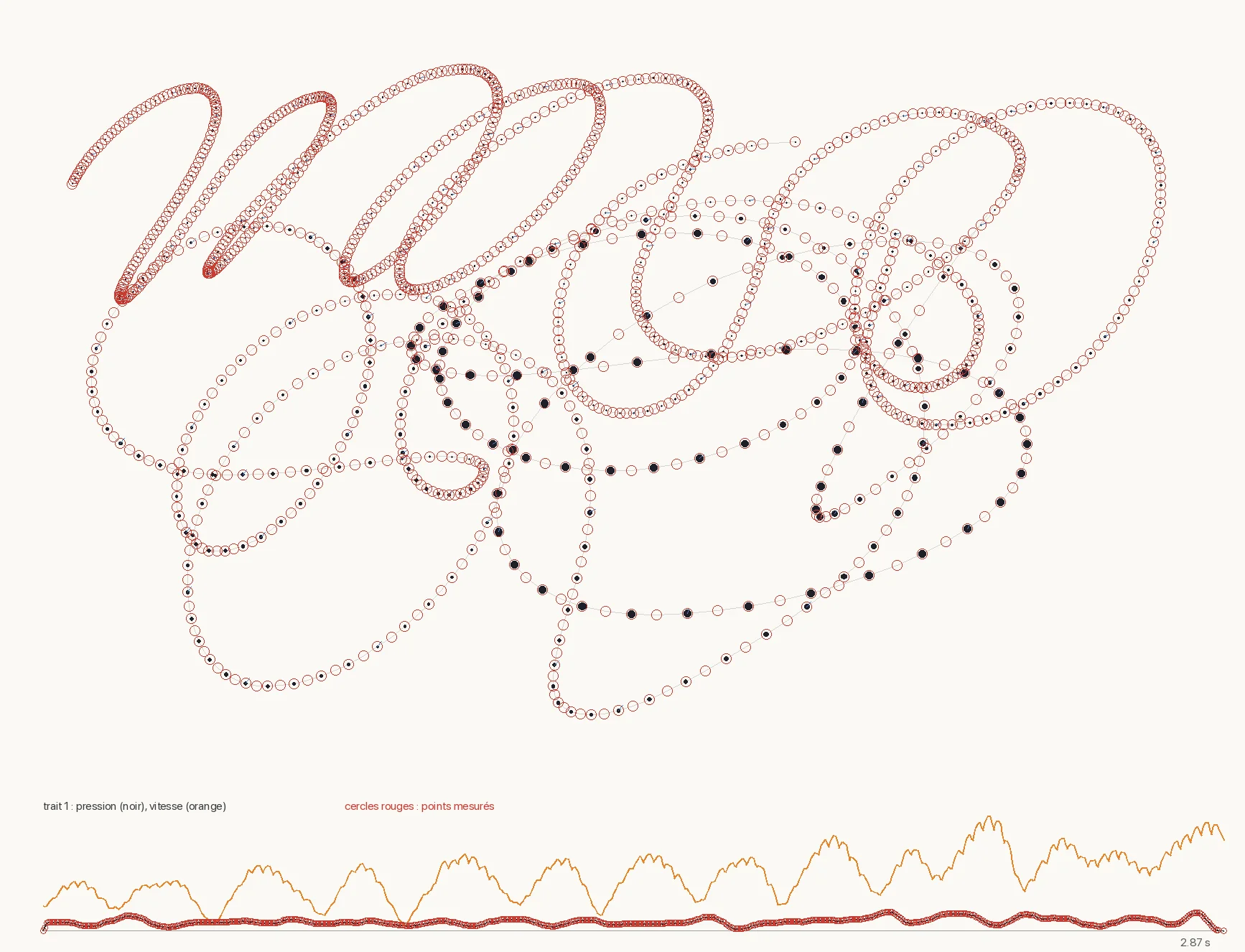
Lecture – Transcription of the gesture (pressure and velocity only)

I like to subject the image to constrained protocols: I fragment it, divert it, overload it. The result is a body of work that often blurs the boundaries between human gaze and machine vision, between capture and creation, between automation and subjectivity.

My main working tool is the browser. Yet over time this browser has become less a tool than a territory: a space crossed by wanderings, experiments and research of all kinds. It is also my place of production, where images are made and where surprises arise, at once a space for seeing and a tool for making. I like to describe my work as a flow, a river in which I fish.

At the origin there is always a technical wonder: a scanned hand, a few lines of code that are enough to set a form in motion, an image surging out of latent space. It leaves me stunned, and I know what is ambiguous about that: what draws me in is often what is unsettling. But I owe it to myself to dive in, entirely. I need to handle things in order to think.

There is something very beautiful in an autonomous technical object. When a script checks the colours, the speeds, the sequences in my place, it sometimes fascinates me more than anything I could do with it. Art is perhaps not where we expect it. And I can no longer quite separate my own part from what was made without me. I like this confusion. I find great freedom in it.

The images that surround us leave little of it: they are read and seen only through the prism of recognisable, identifiable, classifiable subjects. I would rather look for images of another order, the kind that overwhelm us before we have understood anything at all. In them I sometimes bring the painterly gesture and automation together, to question the one through the other.

So it is all about gestures, geographies, impossible quests, at the heart of a digital matter in constant evolution, which we push, which we work, and which so often resists us. I have always loved riddles; when a question seems solved to me, I step away.

In a way, I suppose I am trying to make visible what escapes me: the logics, the narratives, the biases that shape how we see.
Works · 22

01Mother of pearls 2025– Mother of pearls explores the way the browser, with its admittedly limited means, can manipulate images: twist, blend, tear, soften, dissolve them, and so on. 02Puppeteer and Polichinet 2025– In Puppeteer, contact with the interface is delegated to the program. On screen, an autonomous script navigates between web pages, resizes windows, scrolls […] 03Têtes chercheuses 2009– A series of images based on photographs taken at air shows or during retardant drops over forest fires. The aircraft are meticulously erased; only their traces […] 04Delocalized narratives 2020– Based on the Localized Narratives developed by Google Research, this project questions the links between language, assisted vision and erasure. In the original […] 05Mainly water 2022 In Mainly water, each image is an algorithmic exploration of a specific place on Earth, generated from real geographic data. Blending, layering, heightened […] 06Displace 2025– Displace is a video built from a series of images taken from other works, already subjected to multiple manipulations and pushed here to the extreme, until […] 07Work, work, work 2018–2025 The project continuously records the actions of the mouse (moves, clicks, drags, scrolls). The data collected serves as raw material for a series of images. 08Simili 2026– Ongoing research into the painter’s gesture: a program holds the brush, decides on the path, the speed, the pressure and the tilt, and hands these gestures to […] 09Bounding 2016– This project looks at the way algorithms optimise the use of space (in particular for storing and transporting objects or data). It also makes visible images […] 10Containers 2019 Containers is a web page of 24,624 HTML elements (divs) depicting a stack of shipping containers, after a photograph by Martina Nolte (Creative Commons BY-SA […] 11I see faces 2022 A grid of symmetrical lozenges, in black and white, in which the eye very quickly makes out faces. The title, borrowed from a viral Twitter hashtag, echoes the […] 12Tipping points 2022 This work retrieves map data for certain places in SVG format and manipulates it visually with CSS, opening up new perspectives and new viewpoints in space. 13Cartes de profondeurs 2025 These series explore the idea of depth, specifically in relation to the gaze and to vision, through experiments with AI, depth maps in Blender and the “first […] 14Twittheures 2018 This work used the API of the late Twitter to retrieve messages that explicitly mentioned the time, and displayed them on a web page that rotated them (60 […] 15Bit planes 2018 This program, made with Processing, slices an image into layers through its thickness, so to speak, using the principle of bit planes: one layer for each bit […] 16Div Cities 2014 Div Cities is a series of modules using the 3D view of the Firefox developer tools. The idea was to create constructions or monuments within the space of the […] 17Frenetic Bezier Curves 2021 A web page generating frenetic Bézier curves that jitter and bounce until they fall apart. A series of 13 was minted on fxhash (beta version, Tezos blockchain) […] 18Microclimats 2013–2014 A long series of screens captured during a systematic exploration of the coasts of Greenland (mostly), revealing the juxtaposition of satellite images taken at […] 19Naphta 2014 Naphta applies the Project Naptha extension, which recognised the text trapped in images on the web, to a series of works by artists known for placing gesture […] 20Overrules 2014 A systematic and brutal deconstruction of web pages using nothing but CSS. The result is dynamic and animated. 21Patterns 2014 Patternator is a tool for exploring patterns. Some of them were laser-engraved on paper. 22Voir le jour 2016 A memorial listing every moment of an active day, from early morning to late evening, in relation to the moments that follow and precede it: some 6,561 moments.